

This is probably the most recent of the A Gentleman in Moscow reviews! I was late to the party (no pun intended), and only read Amor Towles’s masterpiece this year. It’s going to be made into a TV series, apparently, so if you haven’t already read it, do it now!
[spacer height=”20px”]I really do think it’s one of those books that change your life…at least, it was for me. And it’s my favorite book of all time. If you’ve followed my blog for a while, you know I read a lot of books, so this is not something I say lightly.
It knocked War and Peace out of the number one position, which suggests I have a thing for stories set in Russia, but I really don’t know a lot about Russia in general or spend a lot of time thinking about it. War and Peace is famous for being long, although there are longer books. I read The Tale of Genji in college, for instance. I can’t say I recommend reading the entire Tale of Genji—it didn’t have the kind of narrative arc I look for in a novel, anyway, and it was very repetitive—but it’s certainly enjoyable to read some of it.
War and Peace is usually thought of as boring, too, when it’s very exciting. As the title promises, there are battles, and there’s also romance, and scandal, and a duel, and obsession, and history, and brilliant insights into the human condition, and a certain incident involving a police officer and a bear.
When I first read War and Peace and hit the halfway point, I started over at the beginning so that it wouldn’t end too soon. I’m an impatient person in general and this isn’t at all typical for me. I never did that again…until I read A Gentleman in Moscow.
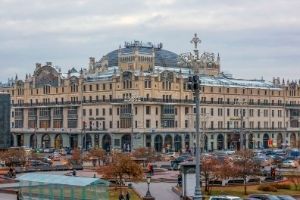
The story begins in 1922, when Count Rostov, charged with the crime of writing an anti-Bolshevik poem, is sentenced to lifetime house arrest at the hotel Metropol (a real hotel across from the Kremlin that I, and no doubt hundreds of thousands of readers, really want to visit someday.) The Count is hustled out of his fancy hotel suite and into a small attic room.[spacer height=”20px”]
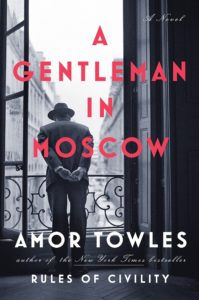
Hi, this is one of those books I`ve put off reading for quite awhile now even though I`ve picked it up in bookstores and libraries, gazed at the cover and then put it back on the shelf lol. Something about the cover attracts me. After reading your discussion of it just minutes ago, I now realize I need to read A Gentleman in Moscow. Haven`t read War and Peace either,, put off by the length of it no doubt! Again, your comments on it have persuaded me to read this book:) So enjoyed your post today, Brynn Donovan!
Hi Carol! It really is such an iconic cover design, I think! I hope you enjoy the book. Hey, if you like it half as much as I did, you’ll love it. Thanks so much for reading the post! I hope everything’s going well with you!
Hi Bryn, Iove that cover of A Gentleman in Moscow, it has an Art Nouveau look to it:) I`ve discovered our library has many copies of the book but they are all checked out at the moment! Think I`ll buy a copy instead, too impatient to wait lol I`ve been reading your blog for awhile and thoroughly enjoy it:) Things are fine here although a little weird with the pandemic going on!! What a year it has been and am so hoping that the coming new year is more normal;) Hope you`re having a great day!
I LOVE stories set in a historical context!
Hi Brian! Meeee tooooo! I haven’t been reading as many lately (and in my day job, we only do contemporary.) I want to get back into reading more! Nice to see you. Hope you’re having a good week!
Beautiful post Bryn. The ability to lead an enriching life through tragedy and deprivation is so typically Russian. I lived in Ukraine and Russia for over three years and this attitude to life begins to inhabit the soul and stay there, rather like a close and very reliable friend. Oddly enough I was reminded of those final words from Albert Camus’ “The Myth of Sisyphus” – “I imagine Sisyphus smiling.” Regarding the length of War and Peace I would counsel any potential readers not to be put off by the length – Tolstoy (and that novel in particular) is not a writer one reads, he is a writer one lives with. And I doubt that many of us harbour a desire to reach the end of our lives as soon as possible. Once again, many thanks for your your insight and sensitivity.
Hi John! Wow, this comment should be a blog post in and of itself. I love it. How fascinating that you lived in Ukraine and Russia for over three years! It must have been such a powerful experience. I never would’ve thought about the ability to thrive through tragedy and deprivation as a typically Russian experience…that’s a great insight. I’ve only read THE STRANGER by Camus, and that ending line is something else. Thank you for this! This comment is going to stay with me.
Thank you for the recommendation. The quote you shared about mastering your circumstances really resonated with my soul.
Stay healthy and happy!
-Katrina
Hi, Katrina! It’s always great to hear from you 🙂 Thank you so much for reading! I hope you’re doing well!
I’ve never heard of this book but would probably like it. I loved The Bronze Horseman set during the Siege of Leningrad, and read (or used to read) quite a bit of Russian authors. Contrary to my expectations, I loved War and Peace.
Some of the life-changing books for me are Martin Chuzzlewit, A Town Like Alice, A Thousand Splendid Suns.
Hi Jennie, nice to see you! We clearly have similar tastes…Martin Chuzzlewit is another one of my faves! I had a literary crush on John Westlock, and Mark Tapley is such an amazing character. I think of him often. I will have to check out some others on your list! The Bronze Horseman sounds so interesting.
I loved this book, too, and loaned it to many friends. However, All the Light We Cannot See was the novel that knocked out my long-standing favorites of Crime and Punishment and Pride and Prejudice. I also tell people to hang on for the first few pages that might be off-putting, at least they were to me. Once I got into meeting the gentlemen, I wanted to stay with him.
Alarie, hi! It’s true—All the Light We Cannot See was absolutely amazing. I love your other faves, too! Persuasion is my favorite Austen novel, but Pride and Prejudice is Gill’s fave. I hope you’re doing well and staying safe!
Yes, we’re staying tucked in, exploring new recipes, and reading, reading, reading. I haven’t felt depressed until now that the holidays are looming. Can’t seem to find any enthusiasm for making ready. On the other hand, we feel pretty fortunate every day.
You have motivated me to read this book. Well done. An extremely well written review!
Oh, I hope you like it! Thanks for reading, Naomi. And thanks for the kind words! Hope everything’s going well with you. 🙂
I have not read the book, but I have felt a weight lifted from my shoulders in the past few days. ‘)
OHHH my gosh. I don’t talk politics much on the blog, but I can’t believe how much happier and more hopeful I feel! My mother said she could feel pains and tension leaving her body, and I believe it. January 20th is going to be a great day.
Hi Bryn
A quick comment from Downunder your appraisal of ‘A Gentleman in Moscow’ convinced me to read it.
Regards
Warren
Hi Warren! Oh, that’s awesome. I hope you like it! Thanks so much for reading, and for commenting. Hope everything’s going well with you! I’m glad the COVID cases in your country are down like they are!
I am glad to read your comments. I can’t tell you how many times I’ve been tempted to buy this novel. I love Russian history, and I’ve read Russian literature. You’ve nudged my interest. I’ll hop on over to Amazon and either download it or buy the paperback.
A book that has stayed with me since I read it many years ago, Nicholas and Alexandra, written by Robert Massie, is an amazing account of the Romanov’s fall. I read the 600+page in a paperback format. Another Russian book I enjoyed is the novel, Child 44, by Tom Rob Smith. It’s set during Stalin’s reign and revolves around a serial killer of children. The horror stories of that regime are told throughout. It’s a series. Implan to read the second one at some point.
Invisible Goodbye, by Tierney James, is set in Russia, and is quite entertaining. It’s part of a special government task force series. The author’s dream is to visit Russia, especially the Kremlin.
Bonnie, hi! Oh, I’m sure you’re going to love it, especially since you love Russian history. Thank you for the recs! I’m especially interested in Nicholas and Alexandra…I really don’t know anything about the Romanovs. I hope you do get to visit Russia—it’s on my list! Maybe you’ll stay at the Metropol 🙂
I was completely absorbed into the N&A book. It spurred me into doing more research. The story of the family is tragic and the question of a possible survivor is still a mystery.
I hope you give it atry. I believe you would enjoy it.
Chances of me going to Russia are nil, but I gravitate toward books and movies in the setting.
Now I’m late to your party–or to commenting on this post, at least! I’m with you on A Gentleman in Moscow being a great book. I absolutely loved it, for many of the reasons you articulated here. The copy I read was from the library, and your post has reminded me I need to get a copy for myself so I can reread this book! It’s interesting what you write about other readers expecting the novel to be grim because of the setting. That, to me, was one of Towles’s greatest accomplishments with the book–always subverting expectations about the people and places in his novel. Thanks for this post, and hope you and yours are well.
Hi, Christina! Not late at all. It’s great to talk to someone else who loved it! I’ve done that before–read a library book, only to decide later that I needed to have it on my shelf. 🙂 Hope you’re doing well and staying safe! Happy Thanksgiving week!